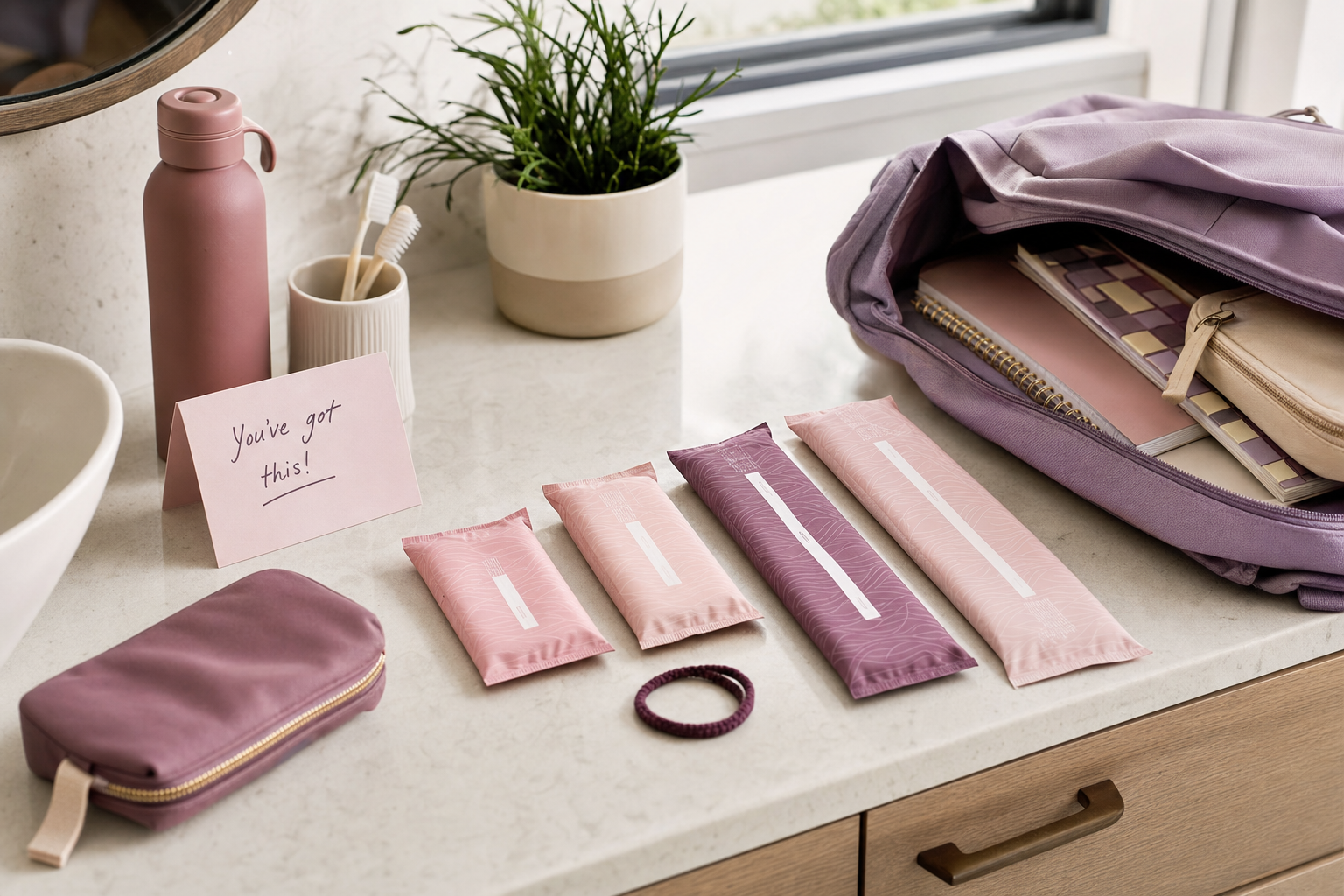
Most of us learned pad sizing like a flow chart.
Light days. Regular days. Heavy days. Overnight.
That is how the period aisle has trained a lot of parents to think.
So when a daughter starts needing period products, it is natural to assume the sizing conversation is mostly about absorbency.
How much protection does she need?
How long will she be out of the house?
Is this a school day, a sleepover or a night at home?
Those are useful questions.
But they may not be the only ones she is asking herself.
For a tween or teen, the “right size” may be less about a label on the box and more about whether she feels comfortable actually wearing it.
The question parents ask is usually: “Will it handle her flow?”
The question a girl may be asking can sound completely different.
- Will it feel bulky when I sit in class?
- Can I move around without thinking about it?
- Will it fit in my backpack pouch without feeling obvious?
- Will I know which one to grab if I am in a hurry?
- Will this make me feel prepared — or make me feel more awkward?
None of those questions are silly.
They are exactly the kind of practical questions that show up when periods leave the bathroom and enter real life: school, sports, car rides, sleepovers, camps and everyday routines.
That is the part a lot of adult products were never built to solve.
Many parents grew up entering the same product category their own mothers used.
Adult pads were the default. Adult language was the default. Adult sizing assumptions were the default.
And if those products worked well enough, nobody questioned it much.
But a younger body is still changing.
A younger routine is still forming.
And a younger girl may not yet have the words to explain why something feels “off.”
She may only know that one pad feels too big, another feels more secure, and another is easier to keep in her backpack.
Five reasons she might choose a pad size that have nothing to do with flow
1. How it feels when she sits, walks and moves.
A product can technically be the “right” absorbency and still feel wrong during a normal day.
If she is aware of it every time she sits down, changes classes or moves around, she may avoid using it — even if it is protective on paper.
2. How confident she feels carrying it.
For girls, the product is not only something they wear. It is something they may need to carry, open and use away from home.
A size that feels manageable in a backpack pouch can make the whole routine feel less intimidating.
3. Whether she can tell what each option is for.
Adults may understand the difference between liner, regular, heavy and overnight without thinking about it.
A girl who is newer to periods may need a simpler way to learn what works for her body and her day.
4. Whether it gives her room to change her mind.
Preferences are allowed to evolve.
What feels best during a first few cycles may change as she grows, gets more comfortable, or learns her pattern.
That does not mean she was wrong before. It means she is learning.
5. Whether the decision feels like hers.
Parents still guide the purchase. Parents still decide what comes into the house.
But when the girl wearing the product gets to notice what feels best, the routine can feel less like something happening to her and more like something she can handle.
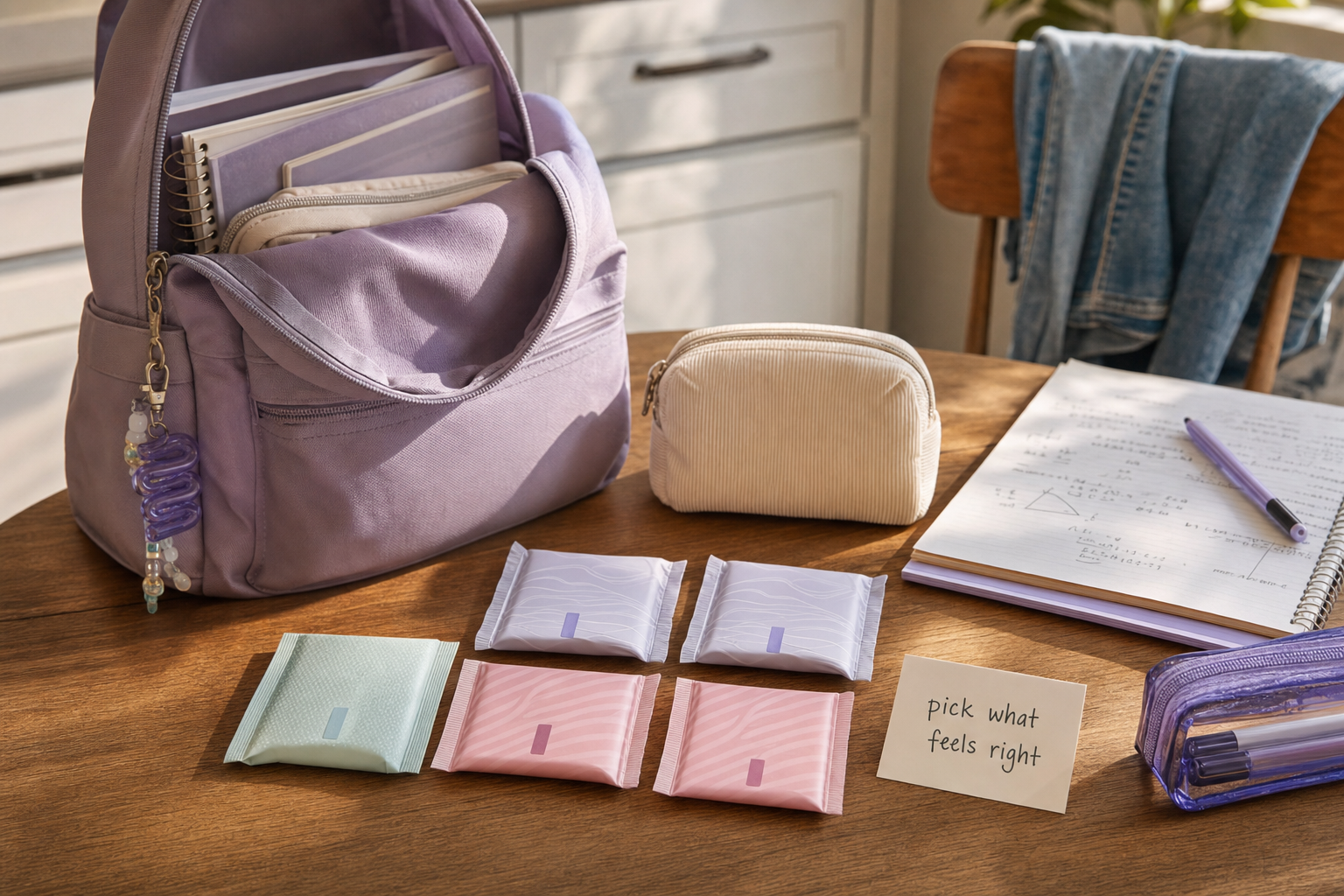
The better starting point: do not make one size the default.
The goal is not to turn period care into a complicated project.
It is the opposite.
Give her a simple way to try different options, notice what feels comfortable and choose what works for her day.
That can be especially helpful because period confidence is built through small, practical moments:
- having a product in her backpack before she needs it;
- knowing which size she likes for school;
- understanding that a heavier day may call for a different option;
- feeling like she has choices instead of one uncomfortable default.
What parents can do without making it awkward
You do not need a big speech.
You do not need to make the conversation dramatic.
A simple, practical approach works better:
- Show her the options. Let her see that pad size can vary.
- Name the purpose. Smaller, everyday, heavier days, overnight — keep it simple.
- Ask what feels comfortable. Do not assume comfort is automatic.
- Pack extras before she needs them. A small pouch can lower the stress of being away from home.
- Normalize changing preferences. If her favorite size changes later, that is normal.
The win is not that she picks the “perfect” pad on day one. The win is that she learns she has options.
That is why Scarlet built the Period Kit around choice.
Scarlet makes period care for tweens and teens — not as an afterthought, but as the starting point.
The Scarlet Period Kit includes four different pad sizes so girls can try options, compare how they feel and learn what works for their body, their flow and their everyday routine.
It is not about deciding for her.
It is about giving her a better starting point.
Because “protected” and “comfortable” should not feel like separate decisions.
Parents care about protection for obvious reasons.
Girls care about protection too.
But they also care about how the product feels in their clothes, in their backpack, at school and in the middle of a normal day.
That is not vanity.
That is the lived experience of using the product.
And when a girl finds an option that feels right, the whole routine can feel a little less mysterious.